Iceland, a sparsely populated, volcanic island in the north Atlantic, is known as the “Land of Fire and Ice” for good reason. Volcanic activity is commonplace, revealed through recently deposited lava fields, steam erupting from underground hot springs through the moss-covered turf, and black pumice-covered trails in the countryside. The earth is volatile in this region. But more than 10% of Iceland’s land mass is covered by ice cap and glaciers, sometimes lying above volcanoes. It is a place of contrast, a land of harsh beauty and hardy people, and an outdoorsman’s paradise. I visited there in August 2015 to trek the Laugavegur trail with friends. My tale begins in Reykjavik, the nation’s capital and the world’s northernmost, where I met fellow Americans Joan Whitacre, Wes Scrivner, Mark and Laura Thompson, and Michele Williamson. Joan, Wes and Mark had hiked together before but the rest of us were just getting acquainted on this trip. We stayed at the Hotel Leifur Eiriksson, which was situated right across the street from Hallgrimskirkja, an iconic church which sits atop a hill in the center of the city and is visible from virtually anywhere in town. This made it easy to find our way back from any walking excursion, using the church steeple as our beacon.
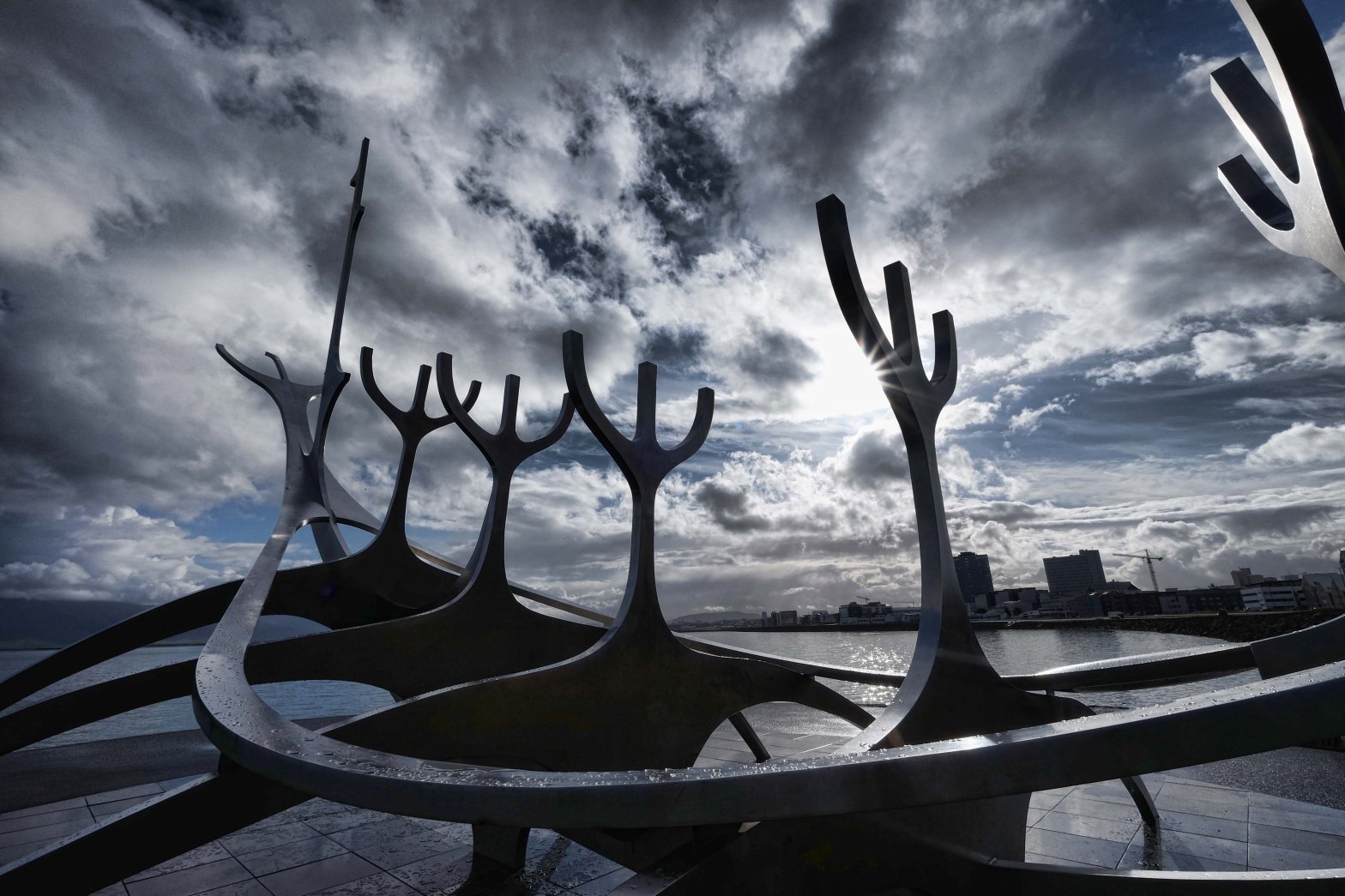
I was the first of our group to arrive in Reykjavik from the U.S. I dropped off my bags at the hotel and walked the city, starting at Hallgrimskirkja, and walking toward the sea along Frakkastigur, where I saw the famous Sun-Craft sculpture by Jon Gunnar Arnason. I enjoyed the scenery along side streets as I strolled, and when the rest of the group arrived (except for Michele, who arrived the next day) we went out walking again, going to a nearby cafe (Cafe Babalu), where we had coffee and my Idahoan friends ran into a fellow Idahoan running the shop. Small world. That evening we walked to dinner and the group finally settled on Prikio, the oldest coffeehouse in Reykjavik, where we ate hamburgers and talked about what better place we might find the next evening. Joan and I also walked to the city’s opera house, Harpa, a spectacular mixture of art and architecture.
The following day we had more time to explore and we walked for hours. Michele arrived from Arizona, and she and Joan and I ate local food for breakfast at Cafe Loki, visited the Settlement Exhibition, walked around lake Tjornin, and returned to Harpa with Laura after dinner. I don’t recall the name of the place we ate dinner that night but I had an excellent seafood soup and felt a bit more as if I were actually enjoying Icelandic food. See the gallery below for photos from Reykjavik, and more narrative and photos about our hike following that.
REYKJAVIK GALLERY
(Click on images to scroll)


Our trek began on August 17, a Monday. A shuttle bus picked us up at our hotel and took us to the bus station where we boarded a larger vehicle to take us to Landmannalaugar, the starting point for our hike of the Laugavegur trail, the most popular hiking trail in the Icelandic wilderness. The trek from Landmannalaugar, located in south central Iceland, to Thorsmork is 55 kilometers in length and usually completed in four days. Ours was an assisted trek with Trek Iceland, which meant they would carry the bulk of our gear and we would need only a daypack as we hiked. They also provided a guide, our meals, and accommodations in the “huts” located along the trail.
Here’s a map and good summary of the technical details of the trek: Laugavegur Trek
Here are my journal entries from the trek:
Day 1, 8/17/15: 6.99 miles from Landmannalaugar to first hut. Didn’t start until after 2 p.m. ~1,500 feet of ascent. Nice weather, no rain this afternoon. Lots of snow, didn’t expect it. Very hard walking. Steam coming from the earth. We walked by the hot spring Storrihver. Lava field littered with obsidian rock (Laugahraun). At the hut (Hrafntinnusker, one of the most remote huts in Iceland), tent campers outside (their tents hadn’t yet arrived). so glad to be inside in the warm hut. We are upstairs in a loft room with mattresses on the floor. Dining room also on top floor. Another room downstairs with bunk beds. Salmon pasta and salad for diner. Outside to the bathroom — snowing.


Day 2, 8/18/15: White out conditions! “No one’s leaving without GPS,” per the Hut Warden. We left about 10 a.m. – long walk in snow and sleet. Very wet and cold. High winds, steep climbs, along the Reykjafjoll mountains, descending into the Jokultungur area. Two river crossings – cold! 18.5 km today — farther than originally planned, not sure why. Hut – Hvanngil – farther than Alftavatn (meaning Swan Lake), which we passed by. Room with spaces for 20, which means 10 double bunks. I am sharing with Michele. So crowded! Toilets a fair walk from the hut. Good to be warm and dry! Had some cell service so could send messages home. Camera getting wet. iPhone getting wet, too. Hands cold. Black Diamond mittens great. Scenes at the hut — young woman being comforted by young man in the mud room, probably the conditions are not what she expected. Tent campers waiting on delayed tents? Washing dishes — Joan in charge. Having to do other groups’ dishes. Was able to send Sophia a postcard from 1st hut. Breakfast was oatmeal and oranges. We made sandwiches to take with us. Heavy bread, cheese, meat, peanut butter, jam, cucumbers, tomatoes. Our guide, Einar, all by himself in this job. A lot for one guide — he has to cook, too.


Day 3, 8/19/15: Didn’t sleep much last night. Got on the trail about 10:15. River crossing (only one today) very quickly after departure. Oatmeal for breakfast again – good. A “TWO SANDWICH” day — not as bad as yesterday — a “THREE SANDWICH” day. Good weather today. No rain, little wind, quite a bit of sun. Gorgeous scenery, through the black glacial desert of Maelifellssandur. Took a side trip to look at Markarfljotsgljufur, canyons almost 200 meters deep carved out by the glacial river Markarfljot, before getting to hut at Emstrur/Botnar. Double bunks again, sharing with Michele. Nicer hut. WCs and showers closer to hut. Three separate huts, 20 persons each. Got a shower — first shower since got on the trail. Got a lot of photos today. Had a little cell service. 16.8k today. Pretty flat. Amazing dessert — Einar’s signature dish. Cookie crumbs on bottom — over chocolate sauce (dark chocolate and coconut milk), then half canned pear, topped with mashed bananas and milk and more chocolate sauce. Great spaghetti and meat sauce and salad for dinner. Food great! Tomorrow breakfast at 8 a.m., departure 9:30, expect 15km. “One water crossing tomorrow,” said Einar. “Is it big?” “You’ve done bigger.” More rain forecast for tomorrow, but who knows. Helen, 74, from Melbourne, Australia. Retired from preparing teachers to teach English as a second language. She really struggled yesterday with the rough conditions and steep climbs. She told Joan that she was proud of herself for the first time in her life. Inspiring.


Day 4, 8/20/15: Finished Laugavegurinn today. 15 kilometers (~55km total mileage for the trek). Not too hard. Good weather. One river crossing. Einar: “Looks like it will be a FOUR SANDWICH day.” He was just kidding, it was only a TWO SANDWICH day. Walked within a few kilometers of the Myrdalsjokull glacier. Arrived at Thorsmork, a green valley beneath the glaciers Eyjafjallajokull and Myrdalsjokull. Birch “forest,” very small trees. But smelled of earth and vegetation like nothing else on this hike. Lush and green. Hut nice. Have my own bunk, hooray! Amazing dinner, Icelandic cod. To bed early for 8 a.m. breakfast and prep for hike. Got wine at shop here. Michele bought. Got a shower too!


Day 5, 8/21/15: Didn’t sleep last night either. Too hot, lots of snoring. Will open a window tonight. Left at 9:30 a.m. to do Fimmvorduhals hike, heading for the mountain pass between the glaciers Eyjafjallajokull and Myrdalsjokull to craters formed in 2010, Magni and Modi (the sons of Thor). Expected to be 20k round trip and elevation gain of 850 meters. It was a spectacular hike! Back a little after 5 and I bought wine to contribute. Enjoyed drinking wine on the patio with hiking friends. Weather very nice. Started raining and we came in. Dinner was grilled Icelandic lamb, potatoes, a dessert made of peanut butter, chopped up chocolate, strawberries and Skyr, served over cookie crumbs and nuts. It’s late and I’m tired, should be helping clean up but am done. Knees hurting from climb. Will rest awhile then go brush teeth and visit the toilet once more. Tomorrow 8 a.m. breakfast, load bags, do day hike, then catch bus to Reykjavik. Ready to get home!


Day 6, 8/22/15: Last climb in Iceland. We hiked to Valahnukur and then to Husadalur for coffee. Watched buses crossing the river at Thorsmork — impressive. Hiked to cave. On the bus for Reykjavik – 3 to 4 hour ride. Multiple water crossings in the bus, would require specially equipped 4WD vehicle. Transfer from one bus to another, about midway. Ate dinner at bus station with Joan, Mark and Laura. Bus to airport hotel. Quiet night, good sleep. Homeward bound.


LAUGAVEGUR TREK GALLERY


FIMMVORDUHALS HIKE AND THORSMORK GALLERY













 susan dragoo